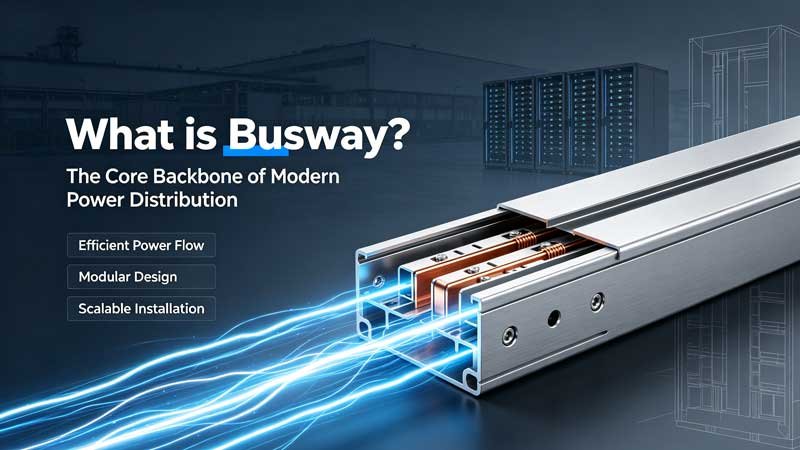
What is Busway? Core Backbone for Modern Industrial & Commercial Power Distribution
What is Busway?
In the fast‑growing industrial and commercial landscape of 2026, demand for efficient, scalable and cost‑effective power distribution solutions has never been higher. As facilities expand, electrical loads rise, and sustainability requirements grow stricter, engineers and facility managers are turning to a proven alternative to traditional cables — busway.
What exactly is busway, and why has it become the preferred power distribution solution across North American and European markets? This article delivers a full breakdown of busway systems: from basic definitions to its transformative advantages over conventional wiring methods.
What Is Busway? Clear Definition
Busway refers to an enclosed metal assembly built with copper or aluminum busbars, designed to deliver high‑power electricity to individual components within a distributed system. For low‑voltage indoor power transmission trunk projects, busway is increasingly replacing power cables.
Per the National Electrical Manufacturers Association (NEMA), a busway (Busway) is a prefabricated electrical distribution system consisting of busbars housed inside a protective enclosure. It includes straight sections, elbows, fittings, devices and accessories. Busway transmits electrical power and connects to switchgear, distribution panels, transformers and other electrical equipment.
Also known as a bus trunk system, a busway is an enclosed power transmission unit composed of metal enclosures, conductive busbars, insulation materials and connection joints. It is widely deployed in high‑rise buildings and industrial plants.
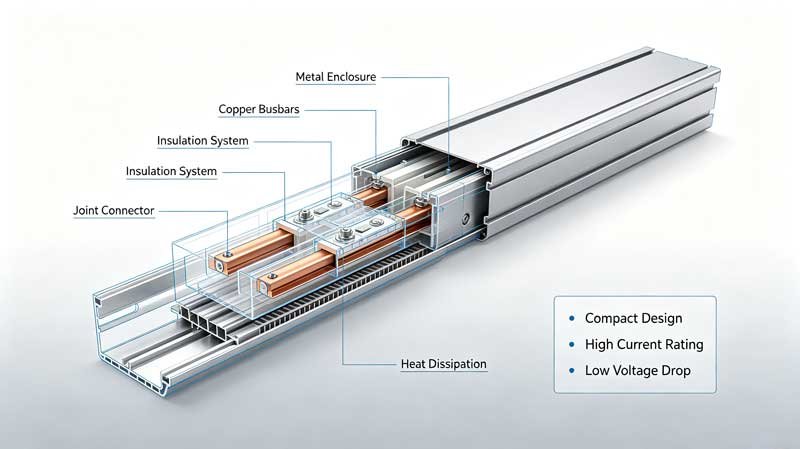
Core Components of a Busway System
A typical busway system comprises four key building blocks:
- Busbars (Conductors): Fabricated from copper or aluminum to carry electric current; dimensions vary according to current ratings.
- Enclosure: Sealed housing made of aluminum or steel. It shields busbars from damage while providing heat dissipation and electromagnetic shielding.
- Insulation System: Constructed with air gaps, epoxy resin, polyester film and other composite materials. It electrically isolates phase conductors and prevents electrical faults.
- Accessories: Elbows, offset adapters, tees and other fittings that route busway for proper electrical interconnection.
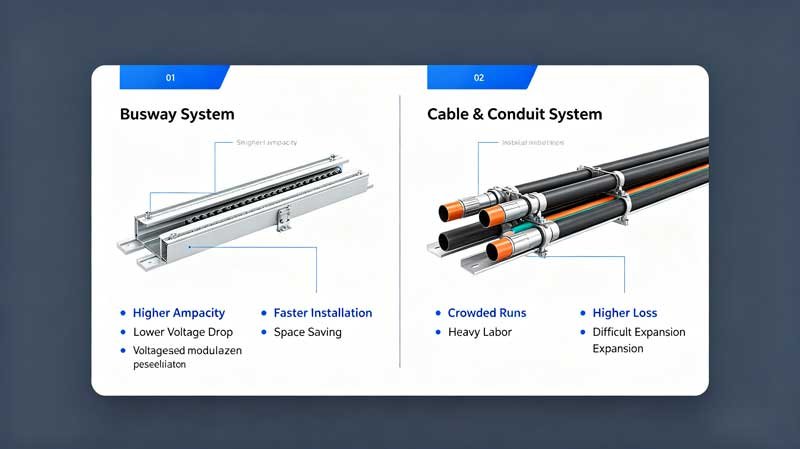
Busway vs. Cable‑and‑Conduit Systems: Why Busway Excels
Both busway and traditional cable‑and‑conduit setups transfer power between electrical devices. Nevertheless, busway delivers distinct benefits across multiple dimensions, making it an outstanding choice for modern power distribution.
1. Superior Electrical Performance
Busway offers higher current‑carrying capacity, better efficiency and lower voltage drop. Thanks to solid‑phase busbar conductors, busway features lower impedance than cables, with voltage drop reaching only 60%‑70% of cable values. Busway voltage drop generally stays below 2%.
Busway holds clear advantages in current‑carrying capacity. Copper or aluminum busbars support large cross‑sectional dimensions. With identical cross‑sectional area, busway delivers 15%‑30% higher ampacity compared with cables. Its maximum rated current can hit 6300A — a performance hard for cables to match. The strengths of busway become especially prominent under high‑current conditions (≥800A / 1000A / 1600A).
2. Noticeable Installation‑Cost Savings
Busway installation is simpler and faster than cable‑and‑conduit work. Plug‑and‑play busway assemblies can be put together by electricians with basic mechanical skills, whereas cable‑and‑conduit installation demands specialized, labor‑intensive work.
Statistics indicate busway installation requires merely 40% of the labor needed for cable‑and‑conduit systems. A skilled tradesperson can fit 100‑150 meters of busway per day, 2‑3 times faster than cable laying. Although busway material costs may run 20%‑40% higher than cables, total installed cost often favors busway — particularly in regions with high labor expenses or projects with tight construction timelines.
From a whole‑lifecycle perspective, busway carries higher upfront costs yet delivers better economics for taller buildings and longer transmission distances. Busway typically serves 30‑40 years, versus roughly 15 years for standard power cables.
3. Space Efficiency & Operational Flexibility
In today’s space‑constrained environments, busway’s compact design removes the need for remote distribution panels and frees up floor space for revenue‑generating purposes.
Tap‑off units can be fitted at various positions along busway without system shutdown to add new circuits. This flexibility proves invaluable for facilities with frequently shifting loads and eliminates costly re‑wiring work.
Take the 1600A application as an example: one compact busway unit handles the full load with minimal footprint and no extra cable tray space. By contrast, cables require multiple parallel runs (e.g. 4×240mm² or 3×300mm² cables). Bulk parallel cables occupy substantial space and demand larger, taller cable trays.
4. Optimized Thermal Management
In high‑temperature environments (above 45°C), busway only loses 5%‑10% of its rated current, while cables suffer 30%‑40% ampacity derating. This makes busway well‑suited for warm‑climate regions or facilities with large heat‑generating equipment.
Compact busway features tightly stacked copper busbars for effective heat dissipation, limited voltage drop and stable performance. Integrated insulation and fewer joints result in extremely low failure rates. Multi‑run parallel cables, by comparison, commonly face uneven current distribution, local hot‑spots and aggravated voltage drop.
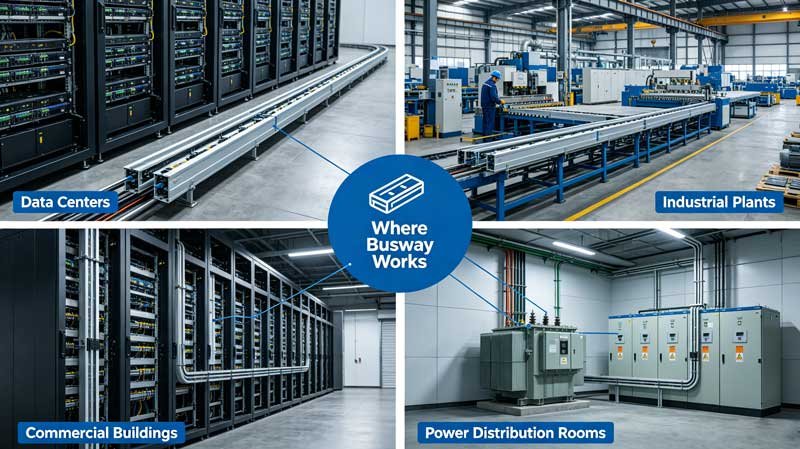
Common Application Scenarios for Busway
As a viable alternative to cables and conduits, busway is deployed across mission‑critical infrastructure.
Data center busway
Data centers represent one of the fastest‑growing end‑use markets for busway. Engineered for heavy power loads, busway fits high‑density computing environments perfectly. Its compact footprint optimizes floor‑space utilization, eliminates masses of power cabling and creates open space around server racks to improve cooling efficiency.
Track busway is widely adopted within data centers. Compared with conventional PDU and cable solutions, it delivers 15%‑30% total‑cost‑of‑ownership (TCO) savings.
Industrial Facilities
Within manufacturing plants and industrial sites, busway provides scalability and adaptability beyond the reach of traditional cabling. Busway segments can be added or repositioned to accommodate new equipment or production‑line adjustments without large‑scale re‑wiring. Tap‑off units mount along busway runs to supply power directly to individual machines or workstations and cut long cable runs.
Commercial Buildings
High‑rise office towers, shopping malls and large mixed‑use complexes benefit from busway’s modular architecture and space‑saving traits. Busway can be configured to match building layouts, with power tap‑offs added or modified as required.
Busway is widely used within power supply systems for substations, large‑scale factories and high‑rises for power transmission and distribution. It features compact structure, broad compatibility and large transmission capacity.
Main Types of Busway
Different operating conditions call for different busway configurations. Below are widely‑used categories:
| Type | Description | Typical Application | Rated Parameters |
|---|---|---|---|
| Feeder Busway | Delivers bulk power from main switchgear to distribution panels | Heavy‑load facilities including auto plants, steel mills and data centers | Up to 6000A |
| Plug‑in Busway | Pre‑defined tap‑off points along the run | Dynamic workshops, manufacturing floors, laboratories | Application‑dependent |
| Compact Busway | Phase busbars stacked within non‑ventilated enclosures | Commercial buildings, general industry, data centers | Up to 600V, 5000A |
| Track Busway | Continuous track design; tap‑off boxes can be installed or removed anywhere on the system | Data centers, laboratories, warehouses | Up to 1000A, 600V |
| Non‑segregated Phase Busway | Copper phase conductors share one enclosure, separated by air‑and‑epoxy insulation | Harsh‑environment sites, utilities, petrochemical facilities | Up to 38kV, 6000A |
Global Market Trends: The Busway Era Has Arrived
The global busway market is witnessing robust growth. Market valuation is projected to rise from USD 3.33 billion in 2025 to USD 3.72 billion in 2026, representing a CAGR of 11.6%. Market size is expected to hit USD 5.42 billion by 2030 at a CAGR of 9.9%.
Alternative market forecasts put the global busway market at USD 12.99 billion in 2025, forecast to reach USD 18.67 billion by 2032. The compact busway market stood at USD 5.66 billion in 2024 and is expected to climb to USD 8.01 billion by 2031.
North America & Europe: Key Growth Drivers
The North American busway market is mature, with focus placed on technical upgrades and energy efficiency. Infrastructure development and energy‑efficiency initiatives drive strong demand. The United States busway market is forecast to expand from USD 2.58 billion in 2025 to USD 4.60 billion by 2033 at a 7.6% CAGR.
In Europe, sustainability regulations and practices boost adoption of energy‑saving busway solutions. The region follows North America in market maturity, with emphasis on sustainability and renewable‑energy integration.
Core Market Growth Drivers
- Rising industry‑wide demand for energy‑efficient solutions
- Expanding data‑center construction, especially for AI workloads
- Industrial automation and facility expansion
- Infrastructure modernization across established markets
- Sustainability mandates including LEED v5 and BREEAM certification requirements
International Standards & Compliance
Compliance with international standards is mandatory for busway products targeting North American and European markets. North‑American specifications are issued by NEMA, UL, CSA, ANSI and IEEE. European and global markets follow IEC standards.
Key Standards
- UL 857: Busway safety standard published by Underwriters Laboratories (UL). It covers temperature‑rise testing, short‑circuit testing, mechanical‑strength testing and more.
- IEC 61439‑6: International standard for busbar trunking systems (busway).
- IEC 61439‑1: General standard for low‑voltage switchgear and control‑gear assemblies.
UL 857 and IEC 61439‑6 represent the two dominant global standards. When sourcing busway suppliers, verified UL certification and IEC compliance are critical for project approval and operational safety.
Why Choose Caogong (CG BUSWAY) for Your Busway Requirements
Caogong (CG BUSWAY) is a leading Chinese busway power‑system brand owned by Guangdong Sike General Electric Power Technology Co., Ltd. As a professional provider of busway power‑distribution solutions, Caogong has built a trusted brand reputation and delivers specialized support for projects requiring reliable, efficient and compliant power‑distribution hardware.
Unique Advantages of Caogong
- Comprehensive Product Portfolio: Caogong supplies full‑range busway solutions, including high‑and‑medium‑current busway lines and miniature busway series, covering diverse industrial, commercial and data‑center use‑cases.
- Commitment to Quality & Service: Caogong holds the industry‑renowned “Five‑Star Service System” certification for busway products, testifying to its dedication to product quality and customer support.
- Global Footprint: With business presence across China and overseas markets, Caogong understands unique requirements for international projects and the importance of meeting global compliance standards.
- Innovation‑Driven Development: Caogong strives to break industry bottlenecks and resolve long‑standing pain points, pushing industry advancement through continuous R&D and technical improvements.
For engineers, contractors and facility managers searching for dependable busway partners, Caogong brings the expertise, product quality and service commitment needed to deliver successful power‑distribution projects.
Conclusion: Busway Is the Future of Power Distribution
As industries across North America and Europe push forward power‑infrastructure modernization, busway systems stand out as the preferred efficient, scalable and cost‑effective power‑distribution solution. Deployed from data centers to manufacturing plants, high‑rise commercial complexes to industrial utilities, busway redefines power‑distribution benchmarks with outstanding performance, measurable installation‑cost savings and unmatched flexibility.
Understanding what busway is and how it reshapes your power‑distribution strategy marks the first step toward building more efficient and resilient facilities. Given projected strong global busway‑market growth, it is time to evaluate busway for your upcoming projects.
Want to learn how Caogong busway solutions can power your facilities? Reach out to our team to discuss your specific requirements and discover why leading enterprises across North America and Europe select busway for their most critical power‑distribution needs.
Appendix: Globally Recognized Busway Brands
Within the worldwide busway marketplace, the brands listed below are widely acknowledged as industry leaders thanks to technical strength, product quality and market influence. They maintain deep customer bases and extensive project track‑records throughout North America and Europe.
- Schneider Electric Headquarters: France Schneider Electric is a global leader in energy management and automation with a strong footprint in the busway sector. Its busway products serve utilities, renewable‑energy sites, commercial buildings, data centers and industrial facilities. Solutions focus on safety, scalability and sustainability to optimize energy flow, cut losses and control expenses.
- Siemens Headquarters: Germany Siemens ranks among the two global market leaders for electrical busway systems. Representing German‑industrial innovation, Siemens busway products are celebrated for premium quality and advanced technology and deployed across diverse industrial and commercial applications.
- ABB Headquarters: Switzerland ABB is a global leader in electrification, automation and digitalization and holds a significant market share in busway. High‑performance copper busbar products from ABB serve industrial and commercial projects, with emphasis on IoT integration and energy efficiency. The company maintains strong operations across North America, Europe, Asia‑Pacific, the Middle East and Africa.
- Eaton Headquarters: United States / Ireland Eaton is a world‑leading power‑management corporation with substantial busway‑market share. Its busway portfolio is known for high reliability and innovative engineering, widely applied in data centers, industrial plants and commercial premises.
- Legrand Headquarters: France Legrand is a global specialist in electrical and digital building infrastructure. Its Starline brand is a well‑known name for track busway. Legrand busway solutions feature modular, innovative designs and enjoy broad adoption within data centers and commercial‑building projects.