
Data Center Busway Solutions: The Next-Gen Power Distribution for AI & High-Density Computing
The rapid expansion of AI training clusters and large-scale language models is fundamentally altering data center power architectures. Rack densities that once averaged 10–20kW are now surging to 40–120kW per rack, with forward-looking designs targeting 300–500kW for next-gen GPU superpods.
In this landscape, traditional “remote power panel (RPP) + whip cable” distribution is hitting physical limits—constrained by ampacity, cable weight, voltage drop, and inflexible scaling.
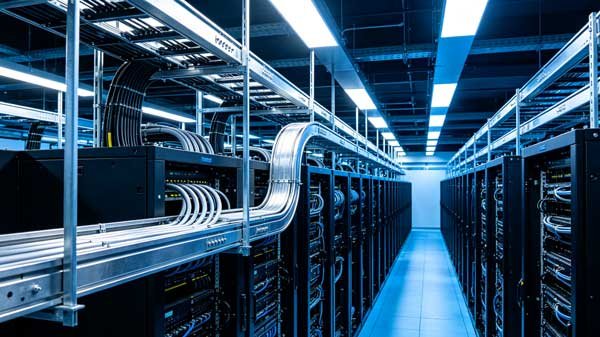
Data center busway (also known as intelligent busbar trunking or overhead power distribution) is emerging as the preferred overhead power distribution solution for hyperscale, colocation, and AI-focused facilities. This modular, plug-in system delivers power directly from the UPS to cabinet PDU via tap-off boxes, eliminating bulky cables and floor-mounted panels.
This report provides a comprehensive analysis covering:
- Product architecture & core components
- Global market size (2025–2035) & penetration rates
- Competitive landscape (Tier 1 global vs. Chinese domestic players)
- Application scenarios: AI GPU clusters, colocation, retrofits
- TCO comparison vs. traditional cable
- Key industry trends: 800V DC busway, smart monitoring, hot-swappable modules
- Critical challenges & selection criteria for operators

Product Definition & System Architecture
Data center busway is an enclosed, modular metallic power distribution system engineered specifically for white-space floor environments. It interfaces with UPS outputs via feeder units, distributes power through busbar trunking, and supplies individual server racks through plug-in tap-off boxes—completely replacing the need for traditional power distribution units (PDUs) and extensive copper cabling.
Core Components:
- Feeder Unit (Tap-off Box): Connects to the upstream LV switchgear/UPS; provides main incoming protection, monitoring, and metering.
- Busbar Trunking (Main Line): Enclosed copper conductors housed in a compact metal casing. Current ratings typically range from 250A to 4000A. For AI projects, sandwich-type / compact laminated busway dominates due to its superior heat dissipation and low impedance.
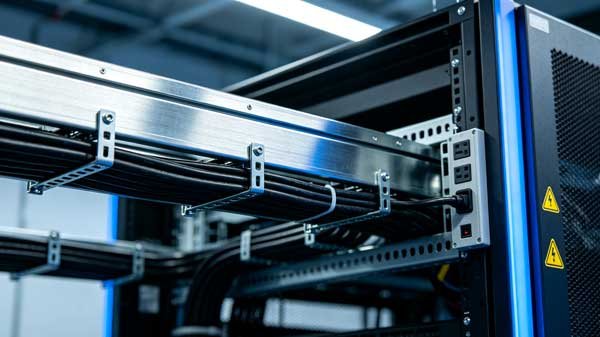
- Plug-in Tap-off Units: Hot-swappable power take-off modules with integrated overcurrent and short-circuit protection. Premium models support true hot-swap (make-before-break) for live capacity changes.
- Intelligent Monitoring Module: Embedded sensors continuously track current, voltage, power, joint temperature, and arc faults, feeding data directly into DCIM/BMS platforms.
Three Primary Mounting Configurations:
- Overhead (Top-of-Rack): Suspended above cabinet rows—currently accounts for >80% of new deployments in 2025, maximizing floor space for IT equipment.
- Under-floor: Used primarily in legacy retrofits or certain financial sector brownfield sites.
- Vertical Busway: Installed inside IT cabinets; typically used for high-density, rack-scale liquid-cooled clusters.
Key Differentiator vs. Traditional Cables:
Traditional RPP/cable schemes consume valuable white-space real estate. Adding or changing racks requires running new cables—often necessitating planned downtime. Busway’s trunk-and-tap architecture allows rack additions or power upgrades via simple plug-in adjustments, recovering 5–8% of usable floor area for additional server deployment, directly increasing compute capacity per square foot.
Market Size, Penetration & Competitive Landscape
2.1 Market Data (2025–2026)
- China Market (2025): Estimated at ¥8.75 billion RMB (~$1.2B USD) . Penetration in new data center builds reached 69.7% in 2025, up sharply from 54.3% in 2023. 2026 projected market size: ¥9.85 billion RMB, representing a 12.4% YoY growth—transitioning from hyper-growth to sustainable expansion. The Beijing-Tianjin-Hebei, Yangtze River Delta, and Greater Bay Area clusters account for 68.4% of national demand, with Guangdong province leading in procurement volume.
- Global Market (2025): Estimated at $815 million USD. Projected CAGR of 7.68% from 2026–2035. Hyperscale cloud providers constitute the largest single segment, representing 44% of global market value.
Key Growth Drivers:
- Greenfield (New Builds): AI training facilities and 10,000-rack+ mega-IDCs driving demand for high-ampacity (4000A+) busway systems.
- Brownfield (Retrofits): Legacy cable-based data centers upgrading to higher densities without major civil works—this is rapidly becoming the second growth engine.
2.2 Competitive Landscape (Three Tiers)
| Tier | Key Players | Strengths |
|---|---|---|
| Global Tier 1 | Schneider Electric, Legrand (Starline), Vertiv, Eaton, ABB | Mature 800V DC products; proven global hyperscale track records; advanced intelligent monitoring. |
| Chinese Domestic Leaders | (Leading local manufacturers) | Deep relationships with local telecoms (China Mobile/Telecom/Unicom) and cloud providers; cost-optimized; strong DCIM integration. |
| Commodity Makers | General-purpose busbar vendors adapting industrial products for data centers | Price-competitive but lack thermal management and arc-flash protection optimized for IT environments. |
Market Concentration: The top 5 players commanded 68.4% of the Chinese market in 2025, with share concentrating further as AI power levels raise technical barriers to entry.

3.1 By Facility Type
- AI Hyperscale (AIDC): 40–120kW/rack and above. Demands high ampacity, low impedance, compact form factors, and 800V DC readiness. Highest value-per-meter segment.
- Colocation (Retail/Wholesale): Multi-tenant environments with heterogeneous rack loads. Core requirements: flexible plug-in provisioning, per-cabinet submetering, and hot-swappable modules for tenant churn.
- Enterprise (On-prem): Corporate, financial, and government data centers. Moderate densities; prioritize high reliability, simplicity, and moderate intelligence.
- Edge Data Centers: Smaller, distributed sites requiring lower current ratings, compact packaging, and rapid deployment.
3.2 By Electrical Architecture
- AC 400V Busway: Current mainstream; mature technology used in most existing and new builds.
- 800V HVDC Busway: The next-generation architecture optimized for AI clusters. Requires enhanced insulation, arc-flash mitigation, and partial discharge control. Current penetration is 10–15% , expected to scale rapidly from 2027–2028, with significant value uplift per unit.
3.3 By Functionality
- Standard (Passive): Power distribution only; no embedded sensors. Used primarily in legacy enterprise facilities.
- Smart (Active): Integrated temperature, current, and arc-fault monitoring. >70% penetration in new hyperscale builds globally, and rapidly becoming a mandatory requirement in Chinese AIDC tenders.
Application Scenarios & Business Value
4.1 Primary Use Cases
- AI GPU Clusters (NVIDIA/AMD/Intel): Overhead busway feeds high-wattage GPU servers, eliminating dense cable bundles and improving hot-aisle containment airflow.
- Telecom Mega-IDCs: China Mobile, Telecom, and Unicom hubs using hybrid main-trunk + rack-level busway architectures.
- Colocation Facilities: Multi-tenant sites requiring frequent power rebalancing—hot-swap tap-offs enable live adjustments without tenant SLA violations.
- Enterprise Mission-Critical: Financial and government sites benefit from fewer failure points and predictive fault detection.
- Brownfield Capacity Upgrades: Replacing cable-RPP systems to boost per-rack power without major structural renovations.
4.2 TCO & Business Value vs. Traditional Cable
| Parameter | Traditional RPP + Cable | Data Center Busway | Advantage |
|---|---|---|---|
| Floor Space | Requires dedicated panel footprint | Overhead mounting recovers 5-8% space | +5–8% more IT racks |
| Installation Time | On-site cable cutting & termination | Factory-preassembled modules | 30%+ faster deployment |
| Capacity Upgrades | Requires new cables; often requires outage | Swap tap-off unit only; hot-swappable | Live changes in hours |
| Energy Loss | Higher I²R losses over long cable runs | Lower impedance; reduced voltage drop | Long-term OpEx savings |
| Maintenance | Manual thermal checks; hard to pinpoint faults | Continuous remote monitoring with alerts | Predictive vs. reactive O&M |
| Total Cost of Ownership (TCO) | Lower CapEx for low-density (<400A) | Higher initial CapEx; 15–30% lower TCO at scale | Long-term ROI for AI densities |
Decision Boundary: For low-current (<400A) or small-scale installations, cable remains cost-effective. However, for high-density, frequently changing environments, busway delivers superior TCO over a 10–15 year lifecycle.
Five Major Industry Trends
Trend 1: High-Ampacity, Low-Impedance Design Becomes Table Stakes
As AI rack densities climb, cable weight and heat become prohibitive. Busway manufacturers are pushing toward higher current ratings in smaller footprints, with strict temperature-rise limits. Overhead (Top-of-Rack) mounting is now the de facto standard.
Trend 2: 800V HVDC Busway Commercialization Accelerates
The industry is moving toward 800V DC distribution for improved efficiency and reduced copper usage. DC busway demands fundamentally different insulation, arc protection, and partial discharge management. While still niche (<15%), pilot deployments are underway, with volume adoption expected post-2027, unlocking a new high-margin product category.
Trend 3: Smart Monitoring Shifts from “Nice-to-Have” to “Must-Have”
Busway is evolving from a passive conductor to an “intelligent sensing device.” Embedded sensors for load, temperature, leakage, and arc faults, integrated with DCIM, enable capacity planning, asset tracking, and predictive maintenance. Major hyperscalers now mandate this in RFPs.
Trend 4: Hot-Swap & Fully Prefabricated Modularity
With AI hardware refresh cycles of just 18–24 months, data centers cannot afford long re-cabling outages. Factory-preassembled busway with true hot-swappable tap-offs allows rack reconfiguration without powering down adjacent equipment. Components are reusable, maximizing capital efficiency.
Trend 5: Liquid-Cooling Ready & Sustainability-Focused
With cold-plate and immersion cooling becoming mainstream, busway products are being adapted for condensation and corrosion resistance. Simultaneously, procurement is shifting toward low-loss conductors, halogen-free materials, and full lifecycle carbon accounting, not just upfront CapEx.
Challenges & Industry Pain Points
- Higher Initial CapEx: The upfront cost of busway systems remains higher than cables, and some smaller operators lack awareness of long-term TCO benefits.
- Interoperability Issues: Tap-off box mechanical and communication protocols vary across vendors, making brownfield integration challenging.
- DC Technology Maturity: 800V DC busway remains relatively unproven in large-scale production, with limited field data on long-term reliability.
- Quality Dispersion: Commodity busway vendors adapting industrial products often lack data center-specific thermal and arc-flash optimizations, posing hidden safety risks for mission-critical loads.
Future Outlook (2026–2035)
As AI compute demand continues its exponential trajectory, data center busway is transitioning from a “premium alternative” to the preferred standard for high-density facilities. Over the next 3–5 years, the industry roadmap is clear:
- Higher current density per unit volume
- 800V DC architectures becoming mainstream
- Full-stack smart sensing embedded at every tap-off
- Rapid-deployment modularity for ever-shorter IT lifecycles
- Liquid-cooling compatibility for next-gen thermal management
Market growth is now dual-driven by new builds and large-scale retrofits. For equipment vendors, differentiation lies not in copper fabrication, but in complete power distribution solutions, digital O&M platforms, and DC technology leadership. For data center operators, procurement decisions must move beyond unit price to evaluate ampacity headroom, safety margins, intelligence capabilities, and total lifecycle cost—critical factors that determine competitiveness in the AI era.